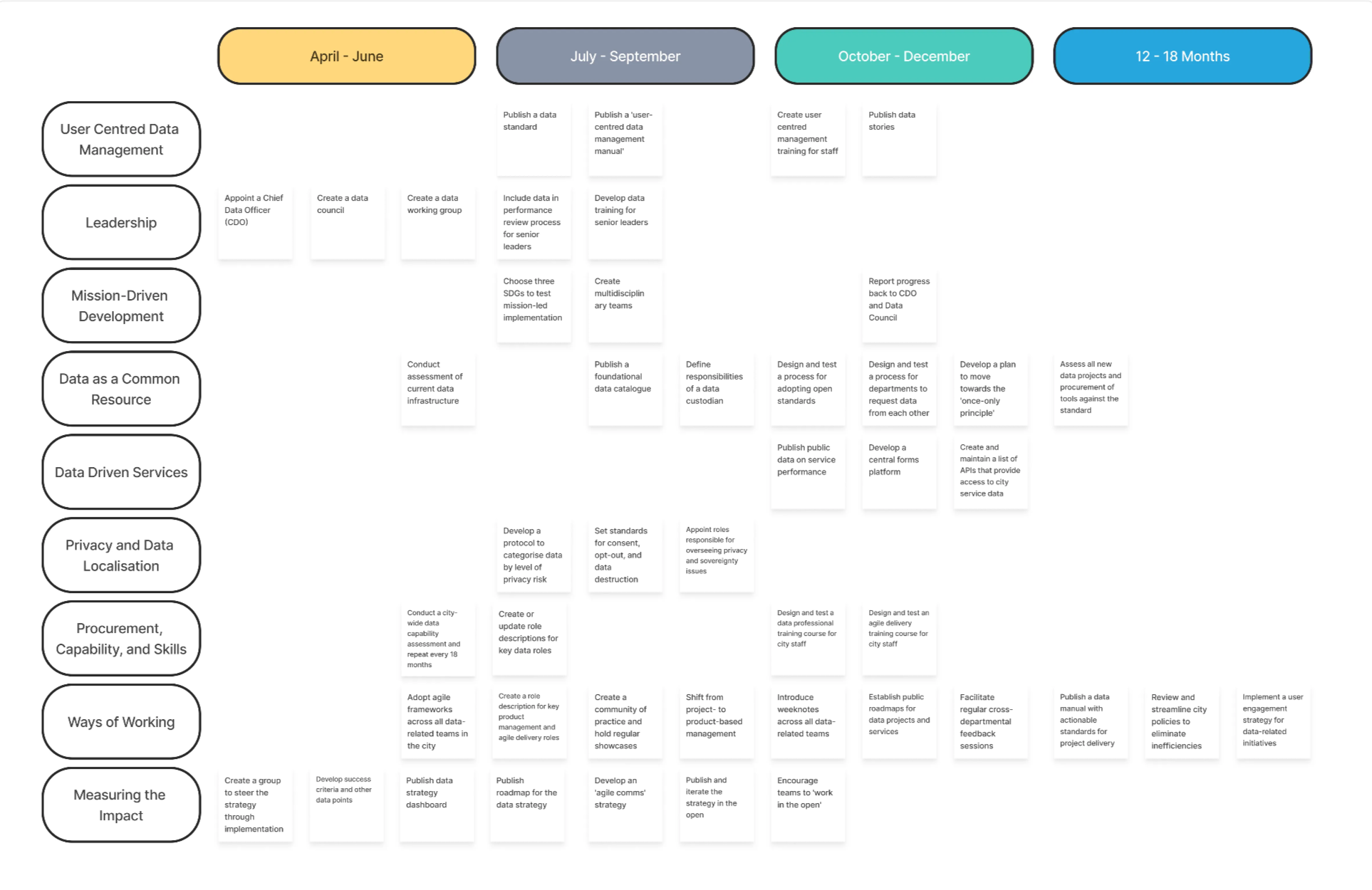
Appendix A. Example Roadmap
Appendix B. Guidance for User Interviews
Government stakeholders and data owners can leverage data user interviews to launch user research processes whenever time and resources allow. Interviews can be semi-structured and low-cost to conduct. In certain cases, for example when interviewing community members for their feedback as potential data users, it is appropriate to offer stipends for their participation.
At the start of user interviews, it’s best to provide stakeholders with information about how information from the interviews will be used and whether it will be shared with people outside of the user research process. This can help to build trust and ensure frank and helpful responses to interview questions. Also, it can be helpful to give stakeholders an overview of the research questions that data owners are seeking to address with their user research interviews (for example, “How do people seek information about healthy food sources in our city?”)
During interviews, it can be helpful to have two people available to support the interview process; one person to ask questions, and one person to take notes. Interviews can strictly follow an interview guide, or can include some unscripted follow-up questions that may add detail to the responses provided. Questions should generally pertain directly to the core research questions or themes of the user research process.
Following interviews, data owners and teams should collaborate to document and synthesise insights. Often, the best insights are contextualised and turned into potential solutions through collaborative conversations among stakeholders. Interview insights can be anonymised before synthesis workshops to ensure that data users are protected from undue backlash for their feedback.
Once insights are synthesised and tagged or categorised by major themes, teams can collaborate to ideate around potential solutions that address the major categories of challenges. These ideas for potential solutions can respond directly to data users’ requests, or can include more creative interpretations of what data users’ communicated as challenges in their responses. Often, data users’ who have challenges with data request certain solutions because these options are the only ones they are aware of, but stakeholders involved in ideation may have insight into other potential solutions that can more aptly address data users’ concerns.
Common Terms and Acronyms
Common Terms
| Term | Definition |
|---|---|
| Agile | An iterative project management methodology that breaks down work into smaller phases called sprints in order to deliver software quickly and adapt to changing requirements. |
| Data Equity | The principles and practices that ensure fair treatment, equality of opportunity, and access to information and resources for individuals in data-related projects. |
| Data Governance | A framework for ensuring data quality, data security and privacy, and data accessibility. |
| Data Stewards | Subject experts with a thorough understanding of a particular data set. |
| Data Custodians | Responsible for implementing and maintaining security controls for a given dataset in order to meet the requirements specified by the Data Owner. |
| Data Localisation | The practice of keeping data within the region or country it originated from. |
| Data Owners | The person accountable for the classification, protection, use, and quality of one or more data sets within an organisation. |
| Data Protection | The practice of safeguarding personal data and sensitive information. |
| Data Visualisation | The graphical representation of information and data. |
| Digital Public Infrastructure | The shared digital capabilities needed to participate in society and markets. |
| Interoperability | Frameworks which allow seamless data integration across systems. |
| Product Management | A role within organisations which is responsible for planning, developing, launching, and managing a product or service. |
| Once-Only Principle | A principle in which governments aim to reduce the amount of information citizens need to provide to public authorities. |
| Open Data | Data that are accessible and freely used by anyone. |
| Roadmap | A tool used to show a product/service will evolve over time - over months, quarters and years. |
| User Centred Design | A methodology and practice which allows teams to design data tools and platforms that meet users’ needs. |
| Weeknotes | A concise way to document your team’s progress, share updates, and communicate next steps to stakeholders or team members. |
Acronyms and Abbreviations
- API - Application Programming Interface
- CDataO - Chief Data Officer
- CIPS - Companies and Intellectual Property Commission
- DSI - Department of Science and Innovation
- DWG - Data Working Group
- FAIR Principles - Findable, Accessible, Interoperable, and Reusable
- GESI - Gender, Equity and Social Inclusion
- HPCDPC - High Performance Computing and Data Processing Centre
- KPI - Key Performance Indicator
- NIPMO - National Intellectual Property Management Office
- POPIA - Protection of Personal Information Act
- RIHA - Estonia’s Riigi infosüsteemi haldussüsteem (Administration system for the state information system)